“I know social media is where you reach people now, but our industry is so boring, I worry about running out of things to talk about.”
This is something I hear all the time when people reach out to me. They know they want to build a presence on social media because they can see the potential and they’ve heard the success stories, but they’re stuck on where to start. There are practical reasons for that: time, resourcing, not knowing what to say, but there’s often something else sitting underneath it too. Many of the people I work with have held off for years because they’re not confident in what they have to say. They assume they’ll run out of ideas, or that they can’t compete with brands that feel bigger, louder, or more naturally suited to these platforms.
I don’t agree with that. I think it’s a framing problem, and it’s one that can be solved.
The Internet Is Already Showing You This
Before going further, it’s worth saying this clearly. When people talk about “boring” industries, it’s not a judgement on the work itself. It’s a perception about how it might translate online.
However, you don’t have to look far to find massive and engaged communities built around things that perhaps don’t sound exciting at first glance.
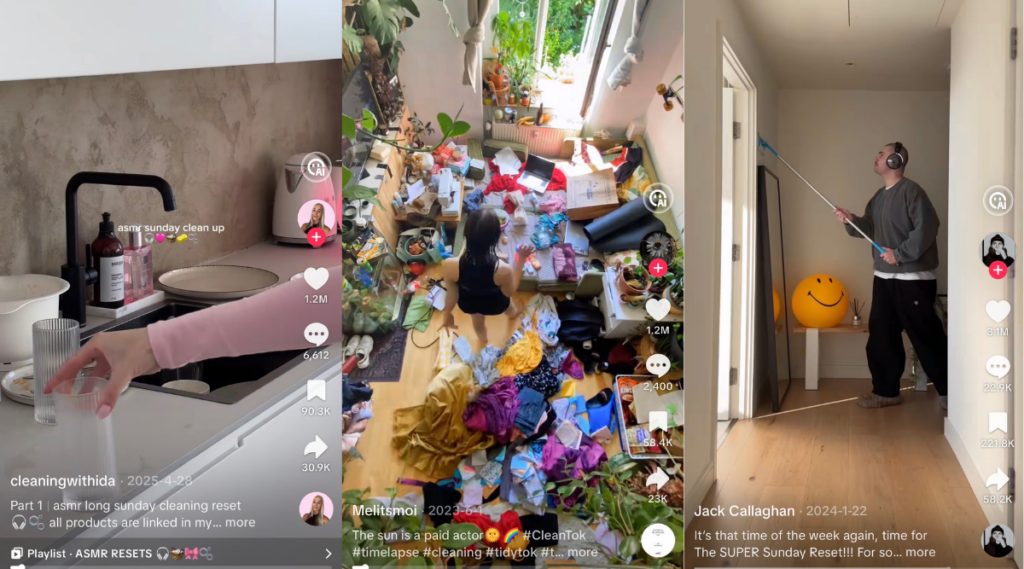
Cleaning content is one of the clearest examples. The hashtag #CleanTok has surpassed 150 billion views on TikTok. That’s not a niche trend, that’s mass attention. Individual creators in that space regularly pull in millions of views on a single video, just by showing someone cleaning a sink, organising a cupboard, or resetting a space.
And it’s not just TikTok. On Reddit, communities like r/CleaningTips have over 2.2 million members and average 19,000 posts a week, all sharing advice, before-and-after photos, and small cleaning wins. These are people actively choosing to spend time reading and talking about cleaning.
Power washing is another one. Videos of someone blasting dirt off a driveway or wall have become a genre in their own right. Content tagged with things like #powerwashing and #cleaningcompilations has accumulated billions of views across platforms. There are entire YouTube channels built around nothing but this, pulling in hundreds of thousands, sometimes millions, of views per video.
Then you have industries that are even less visual on the surface. Developers sharing coding tips, breaking down problems, or walking through builds. Finance creators explaining tax mistakes or common pitfalls. Logistics professionals walking through what actually happens when a delivery goes wrong. Manufacturers showing how something is made, step by step. These aren’t traditionally “entertaining” fields, but the content works because it’s useful, specific, and targeted.
What’s consistent across all of these isn’t the industry suddenly becoming traditionally more interesting. It’s that the content is being framed in a way that makes sense to the audience. It’s useful, satisfying, clarifying, or relatable in a very particular way.
There is an audience for all of it.
The Real Issue Isn’t the Industry
What usually gets in the way isn’t the subject matter; it’s a lack of clarity. When you’re not clear on who you’re speaking to, what they care about, or where they spend time, content starts to feel like guesswork. That’s when people fall into the habit of trying a bit of everything, posting inconsistently, jumping across platforms, and hoping something lands.
There’s also a lot of pressure to be everywhere at once. Every platform, every format, all at the same time. It’s not necessary, and for most people it’s a waste of time and energy. If your audience isn’t there, it doesn’t matter how much you post.
You’re far better off focusing on one or two platforms that are a good fit and doing them properly. Showing up consistently, learning what works, and building from there. Testing and iteration are important, but they should be intentional. If you have limited time and resources, you want your efforts to be moving you closer to the people you’re trying to reach, not just filling space.
Start With Who You’re Trying to Reach
Before you think about content, start with your audience. Who are you actually trying to attract?
Go beyond broad categories and build a clearer picture:
- Where do they live?
- How old are they?
- What does their day-to-day look like?
- What are they trying to figure out right now?
- What problems can you help them solve?
- What do they spend money on?
- What else are they interested in?
- How much knowledge of you / your industry / your services will they bring to an interaction?
- What do they find funny, frustrating, useful, or worth sharing?
A good place to start is with the conversations you’re already having. What are people asking you? Why do they come to you in the first place? What do you find yourself explaining over and over again? That’s your baseline, and it’s where your content should come from.
Then Find Where They Already Are
Once you know who you’re trying to reach, the next step is to find where they spend time online. This is where people often get stuck, because “go find your audience” is easy to say and not always obvious to do.
Start simple. On Reddit, search for keywords related to your industry or your audience’s problems. Look for threads where people are asking questions or sharing experiences, and pay attention to which posts have the most comments or upvotes. On TikTok, use the search bar and type in phrases your audience might use, then look at suggested searches and scroll through videos that are gaining traction. Read the comments. That’s often where the real insight is.
On YouTube, search for similar topics and look at what videos are getting views and engagement. Check the comments to see what people are asking for next. On LinkedIn, look at posts from people in your industry or adjacent spaces and see what sparks conversation, not just passive engagement.
You’re not just looking for content ideas. You’re learning how people talk about these topics, what they care about, and what actually holds attention.
Then Speak to Them in a Way That Resonates
Once you understand who you’re talking to and where they are, the content becomes much clearer. You’re not trying to come up with something clever for the sake of it. You’re responding to real needs.
That might mean answering a question you get all the time, breaking down something people find confusing, showing a process they’ve never seen, or sharing a small insight that makes their life easier. The same industry, presented with that level of awareness, doesn’t feel boring. It feels relevant.
Make a Plan and Give It Time
This part matters more than people expect. You don’t need to go from zero to posting every day overnight. In fact, that’s usually where teams burn out.
Take the time to plan and bank some content before you start so you’re not constantly scrambling for ideas. Think about the kinds of posts you want to be known for and how often you can realistically post. Building an audience takes time, and you’re not going to post a handful of videos and suddenly have everything click into place.
The early stages are about learning, refining, and staying consistent. If you go in half prepared and expect immediate results, it’s easy to give up too soon. If you approach it with some structure and patience, it compounds.
DO NOT Ignore The Comments
One thing I reiterate to all of our partners is that you must be responding to comments.
It’s one of the simplest things you can do, and one of the most overlooked. Social media isn’t just a broadcast channel; it’s a conversation. When someone takes the time to comment, they’re giving you an opening. Ignoring that is like walking away mid-conversation.
It’s also one of the fastest ways to build momentum early on. Replies signal to the platform that your content is worth engaging with, and they signal to your audience that there’s real people behind the account. That matters more than people think.
Final Thought
If you feel like your industry is too boring for social media, it’s worth questioning that assumption. There are audiences for everything, and there are niches for everything.
The difference is whether you’re being intentional about how you show up. This means knowing who you’re trying to reach, understanding where they are, and taking the time to communicate in a way that’s genuine.
There’s no such thing as a boring industry. It’s just a matter of whether you’ve found the right way to talk about it yet.
And if you’re ready to get started but not sure how, reach out. We’ve got plenty of ideas to get you moving.

Claire Joachim | Managing Director